

Saying no is not my strongest skill.
Thanks to my neurology and my childhood programming, my nervous system finds it easier to just say yes to things that people ask me to do, especially when I’m already depleted and overstimulated. It’s much harder to summon up the courage and mental clarity to say no—and then face their unhappy feelings.
But that’s not the type of person I want to be (and definitely not the type of mother I want to be!).
I want to be strong and authentic, showing up in my relationships with integrity and mindfulness. I want people to be able to be their real selves with me, trusting me to operate with boundaries and self-respect, so they don’t have to fear that they’re burdening me, etc.
I’ve been working on this for many years. Probably I’ll always be working on it! I’ve written plenty about this learning here previously, such as in these posts:
“Living Self-first” (poem)
“I’m a Real Person” (song)
“Learning to Uphold Myself” (essay)
After a lot of practice, I’ve found a basic process that helps me “hold my no’s,” as it were. (It can involve metaphorically holding my nose as well!)
I think it’s easiest to explain visually, so I drew up a little cartoon:
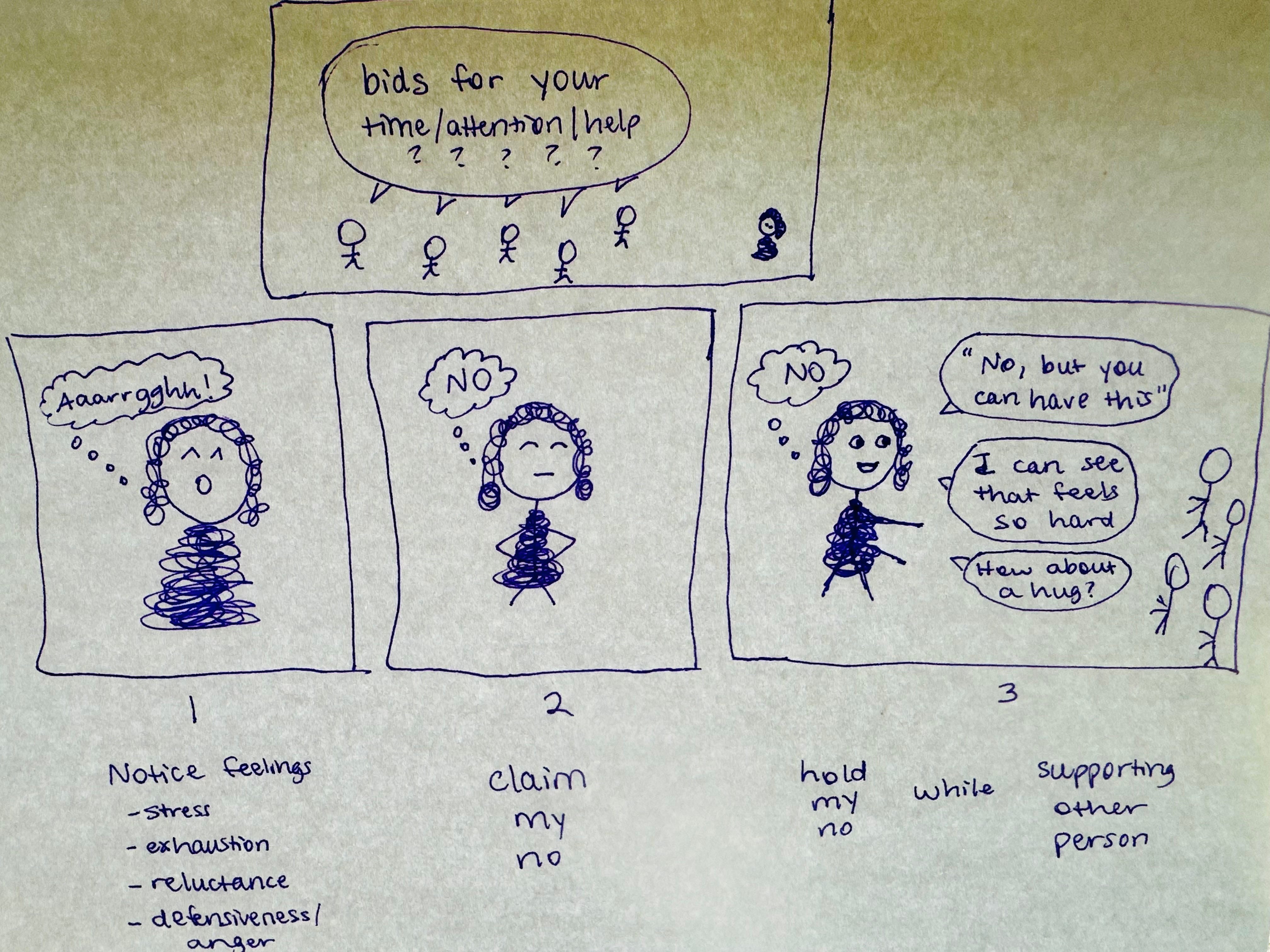
Here are the three steps in words:
Notice how I feel: if someone asks me to do something, and my mind goes “Aaaaarrgggghhh,” that indicates that I am feeling stressed, overwhelmed, defensive, reluctant, frustrated, and/or exhausted…and that means I need to say no.
Claim my no. This means making the decision to say no. It may also involve 1) recognizing that I need to say no (see previous step), 2) remembering that I have the right to say no, and 3) preparing myself to deliver the no.
Say no with support to the other person. The key is keeping the focus on empathizing with them. This keeps the focus—both mine and theirs—off of defending, justifying, or reconsidering my “no.”
When I inwardly hold my “no” while outwardly supporting the other person’s experience, what results is immeasurably more peace and less drama than when I’m wishy-washy or defensive.
I don’t always succeed, but having this as a goal helps me correct my course when I get off it.
For example, yesterday evening, I reacted defensively to a kid’s request, saying with a sigh, “I don’t think I can do that right now; it’s just too hard…” Then, when she pushed back (“Why is that hard?”), I felt aggravated and began listing reasons. Then I heard myself. I stopped mid-sentence and said, in a much gentler tone, “I can’t do that right now, honey, but maybe tomorrow. I know you really want it.” Then we were both able to move on calmly.
I am reminded of this quote from (once again) Harry Potter and the Methods of Rationality:
“The more you try to justify yourself to people…the more it acknowledges that they have the right to question you. It shows you think they get to be your inquisitor, and once you grant someone that sort of power over you, they just push more and more."
— from Harry Potter and the Methods of Rationality, chapter 48
Indeed: when I defensively try to explain myself to someone, I am really just handing them my power.
Healthy boundaries—and actual self-defense—looks like calmly and quietly standing my ground.
In other words, holding my no’s.
I’ll close with one of my learning poems, previously posted as a Serenity Splash poem here. This is what I’m trying to learn.
I tend to blend myself with them
(down deep, I’m tremulous)
when they blend with their feelings
(all comingled, nebulous).In their dysregulation storms,
my sense of “me” needs tended,
so I can be our lighthouse,
standing boundaried, not blended.
Thank you for witnessing my learning journey. Please share any wisdom or resonating experience you have with this!
I have a tough time with "no" too. This is a great reflection on how to make it work, though! 😁